Night guard for bruxism (occlusal splint): how it works and how long it lasts
An occlusal splint protects teeth from grinding. We explain how it works, the types, why it should be custom-made, how to care for it and when to replace it.
 Reviewed byDr. Andreina Armas · Specialist in Oral Rehabilitation and Cosmetic Dentistry5 min read
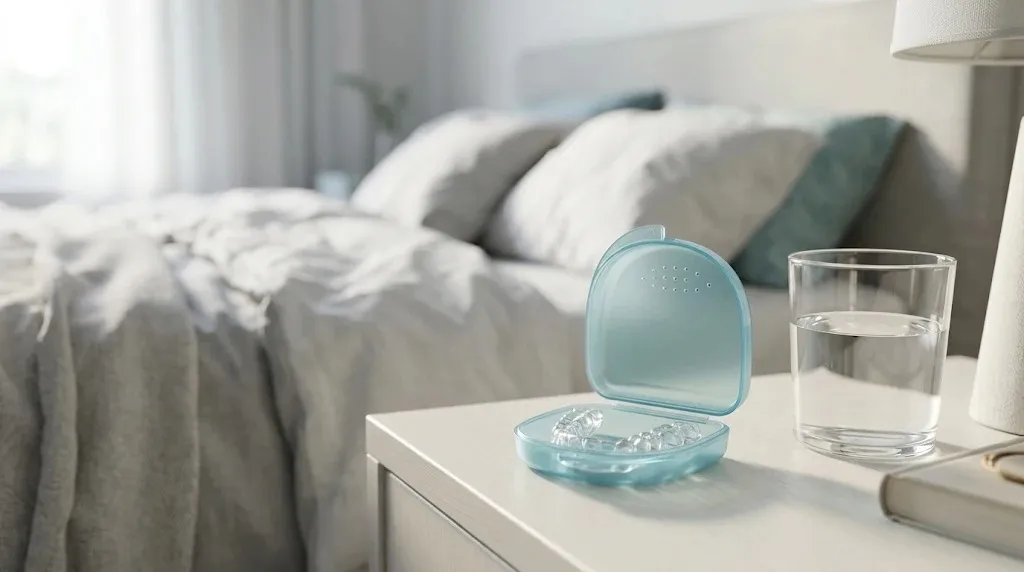
A night guard for bruxism — also called an occlusal splint or bite splint — is a removable appliance, usually made of rigid acrylic, worn over the teeth while you sleep. Its job is to protect the teeth and distribute forces when you clench or grind.
How does it work?
- Physical barrier: wear happens on the guard, not on enamel or restorations.
- Force distribution: its smooth, balanced surface spreads loads evenly.
- Muscle relaxation: a stable bite on the guard reduces muscle activity in many people.
It does not remove the cause of bruxism, which is related to sleep and stress, but it prevents the consequences. Learn more in bruxism symptoms and causes.
What types are there?
| Type | Material | Recommendation |
|---|---|---|
| Custom rigid | Hard acrylic | The indicated option for bruxism |
| Dual-laminate | Soft inside, hard outside | An alternative for more comfort |
| Custom soft | Flexible material | Limited use; wears quickly |
| Over-the-counter | Boil-and-bite thermoplastic | Not recommended as treatment |
Why should it be custom-made?
A custom guard is made from an exact record of your mouth — an impression or intraoral scan — and adjusted to your bite in the office. Generic soft guards lack that adjustment: they can invite “chewing”, increasing muscle activity, and over time may alter tooth position.
How do you care for it?
- Wash it with cold water and a soft brush when you take it out. No hot water: it warps.
- Avoid abrasive toothpaste; mild soap works.
- Store it dry in its ventilated case.
- Keep it away from pets and heat.
- Bring it to your check-ups.
How long does it last and when should it be replaced?
It depends on how hard you clench. A rigid guard usually lasts several years. It should be reviewed or replaced when:
- It has holes or cracks.
- It is loose or no longer fits (for example, after new restorations).
- The surface has lost its adjustment.
What is the process?
Evaluation, a record of your mouth, delivery with bite adjustment and a check-up a few weeks later. To protect your teeth, learn about bruxism treatment with Dr. Andreina Armas.
Frequently asked questions
Does the guard go on the upper or lower teeth?
It can be made for either arch. The dentist chooses based on your bite, restorations and comfort.
How long does it take to get used to it?
Most people adapt in one to two weeks. More saliva or slight pressure at first is normal.
Can I wear a guard if I have veneers or implants?
Yes, and it is especially recommended: it protects the investment you made in your restorations.